About ShaTranj
The Faces behind ShaTranj
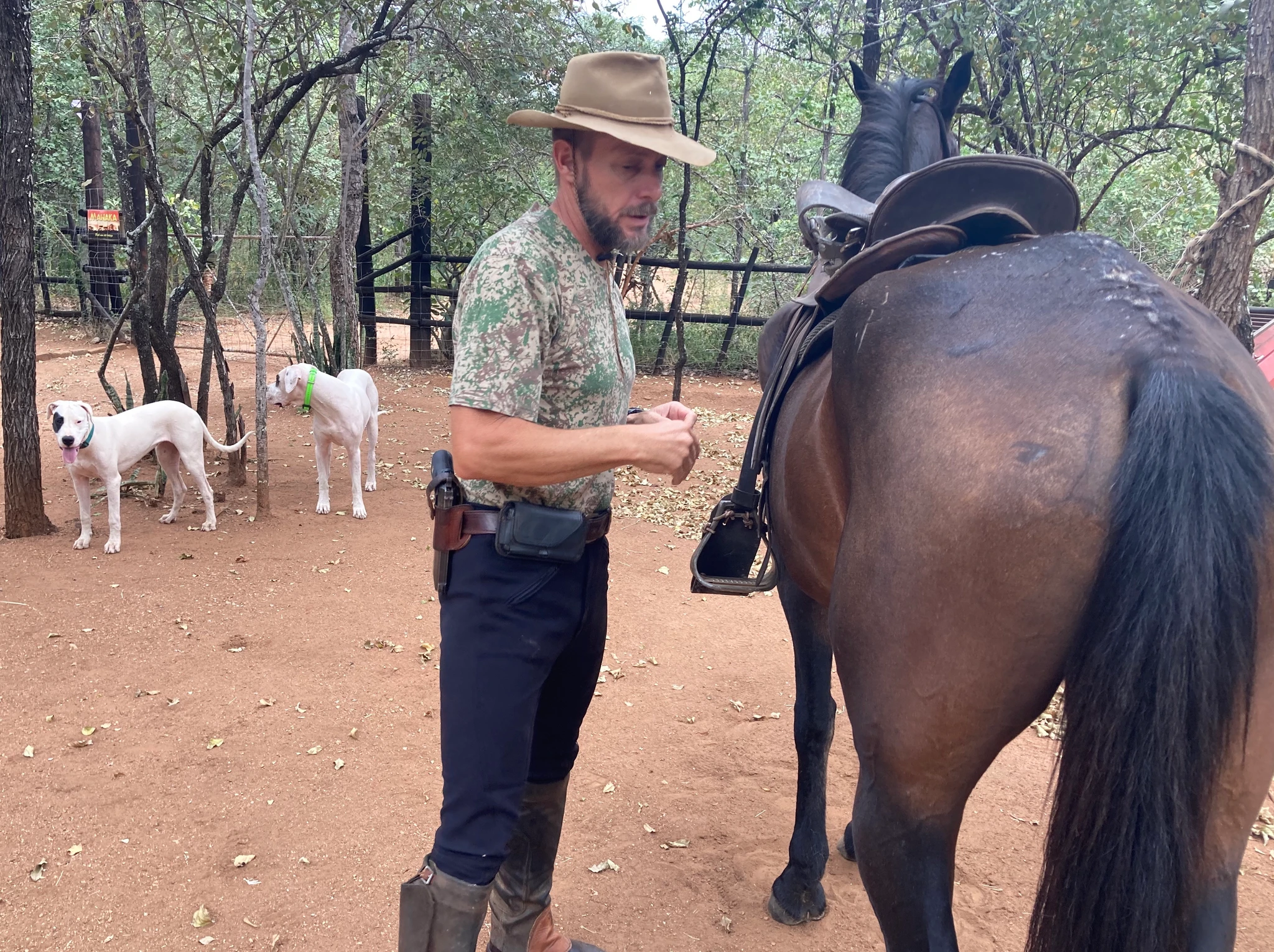
Johan and Marcia de Bruto, a husband and wife team who both loves dogs, horses, cattle, game and being outdoors !
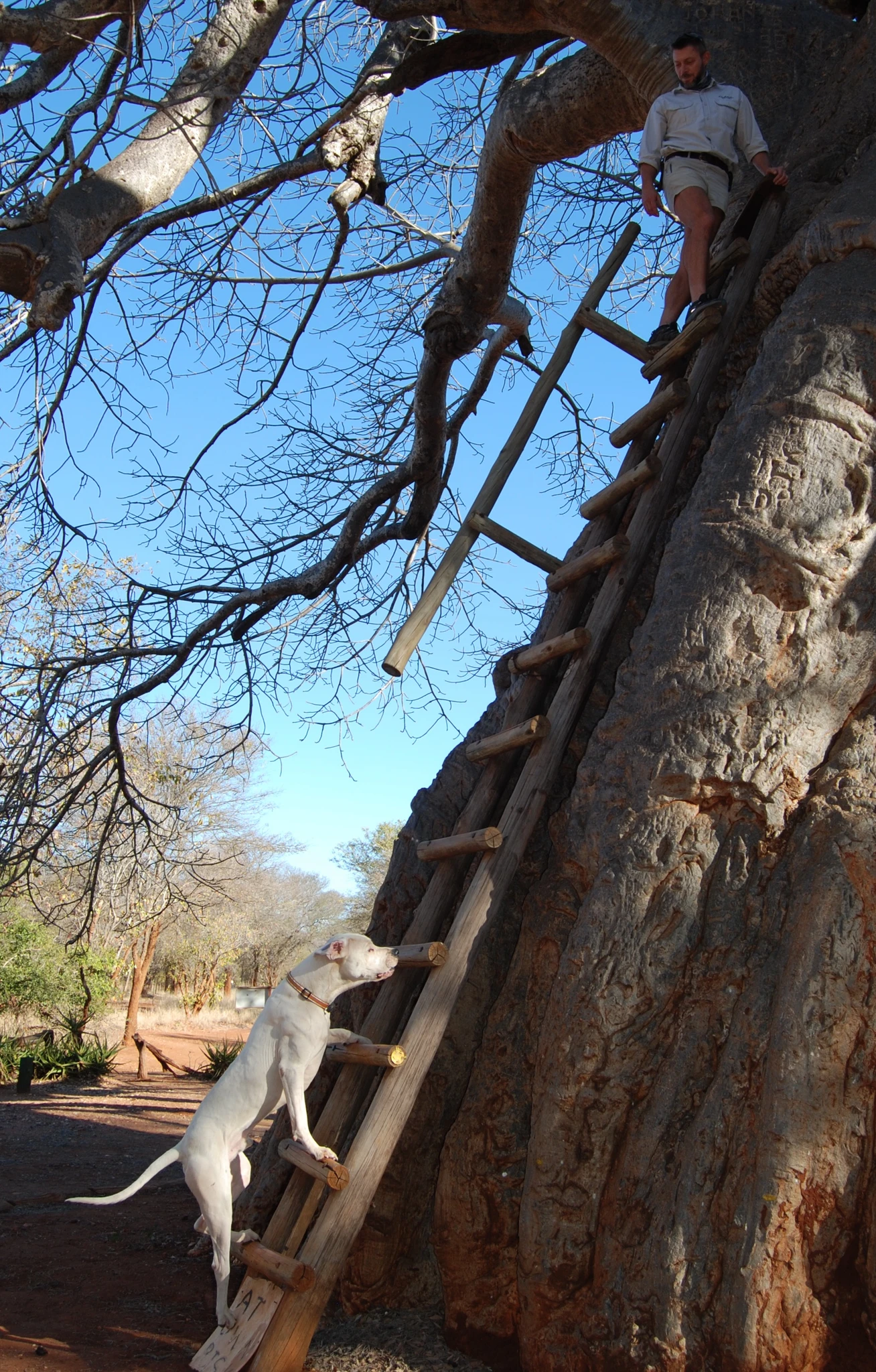
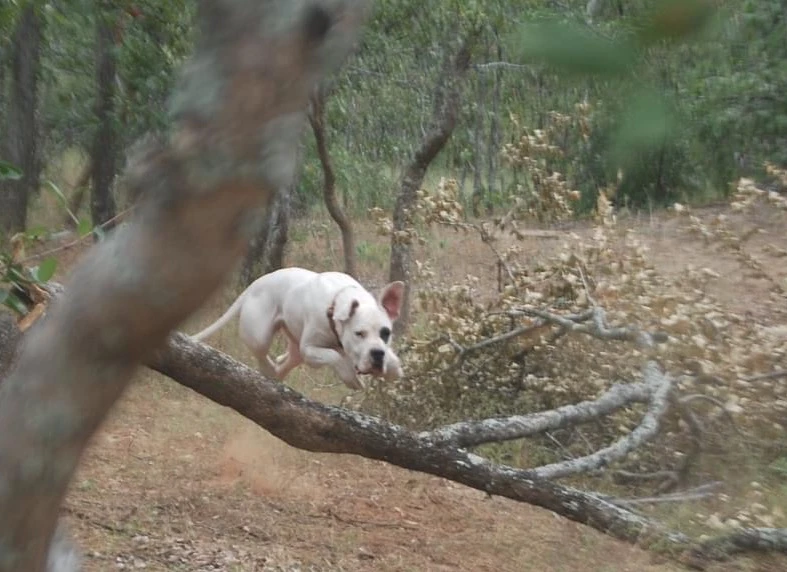
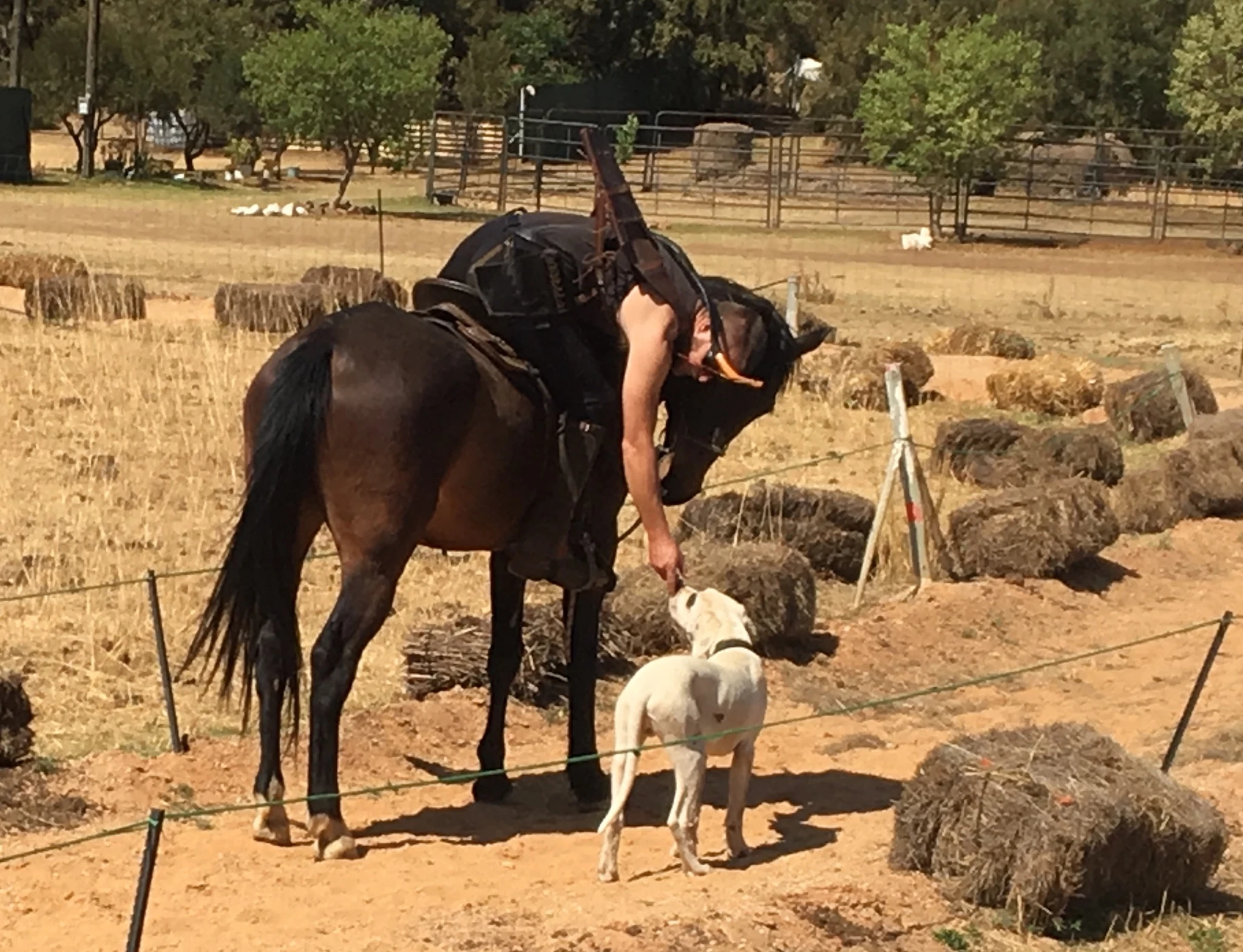
Being Founder members of Mounted Archery in South Africa and both having received Protea colors, we quickly found a way to align our love and ability with horses with our love for the Dogo Argentino and began using them in combat planning, tracking, hunting and anti poaching.
Many years as Endurance riders, added to mounted combat skills, added to training and breeding Dogos, placed us in a unique position to be able to have real working Dogo Argentinos in Africa.
Today we have 16 working Dogos and combine them with our Arabian horses and now also Blue tick coonhounds to form a formidable team in the field.
About the Dogo Argentino
BREED HISTORY
The Argentinian Dogo is a large, white, muscular breed of dog that was developed in Argentina primarily for the purpose of big-game hunting, including wild boar.
In 1928, Antonio Nores Martinez, a medical doctor, professor and surgeon, set out to breed a big game huntingdog that was also capable of being a loyal pet and guard dog. He wanted a dog that would exhibit steadfast bravery and willingly protect its human companion. Martinez picked the Cordoba Fighting Dog to be the base for the breed. This breed is extinct today, but it was said that, as a large and ferocious dog, it was a great hunter. Martinez crossed it with the Great Dane, Boxer, Spanish Mastiff, Old English Bulldog, Bull Terrier, Pyrenean Mastiff, English Pointer, Irish Wolfhound and Dogue de Bordeaux. Nores Martinez continued to develop the breed via selective breeding to introduce the desired traits.
Its strength, tenacity, sense of smell, and bravery made it the best in the pack of dogs to hunt wild boars, peccaries, pumas, and other predators of agriculture and livestock that inhabit the vast and diverse regions of Argentina. This is the traditional activity for which Antonio Nores created this breed.
By 1947, the breed had been established, and its genotype and phenotype were stabilised. The same year, the breed standard was presented at the Hunter’s Club in the City of Buenos Aires.
In 1964, it was recognised as a breed by the FCA (Federación Cinologica Argentina) and the Sociedad Rural Argentina, which opened their stud book to initiate registry.
In 1970, Dr. Raul Zeballos brought the first six specimens of Argentinian Dogo to the United States.
In 1973 the breed was accepted by the FCI. This was possible thanks to the great passion and unique work and effort of Dr. Agustín Nores Martínez, brother of the founder of the breed, who achieved this recognition, not only because of his individual actions, but also from the institutional action of the FCA and the Dogo Argentino Club, and Dr. Antonio Nores Martinez.
Dogos are big-game hunters ,S&R dogs,police assistance, service dogs, guide for the blind, competitive obedience, Schutzhund and military work.
The Dogo is an intelligent and courageous dog with a strong, natural instinct to protect its home and family. Dogos are very social dogs and are happiest when included in all family activities.
Dogos make a strong distinction between familiar people and strangers, so it is imperative that they be well trained and socialized at an early age.
DOGO ARGENTINO BREED STANDARD (KUSA-Kennel Union of Southern Africa)
Most recent changes to this Standard have an effective date of 01/01/2020 for KUSA registered dogos
WORKING GROUP:
Dogo Argentino
FCI Standard No 292: DOGO ARGENTINO
FCI Classification: Group 2: Pinscher and Schnauzer, Molossoid type dogs, and Swiss Mountain and Cattle dogs
Section 2.1. Molossian breeds, Dogue type
Without Working Trial
ORIGIN
Argentina.
UTILISATION
Big-game hunting dog.
GENERAL APPEARANCE
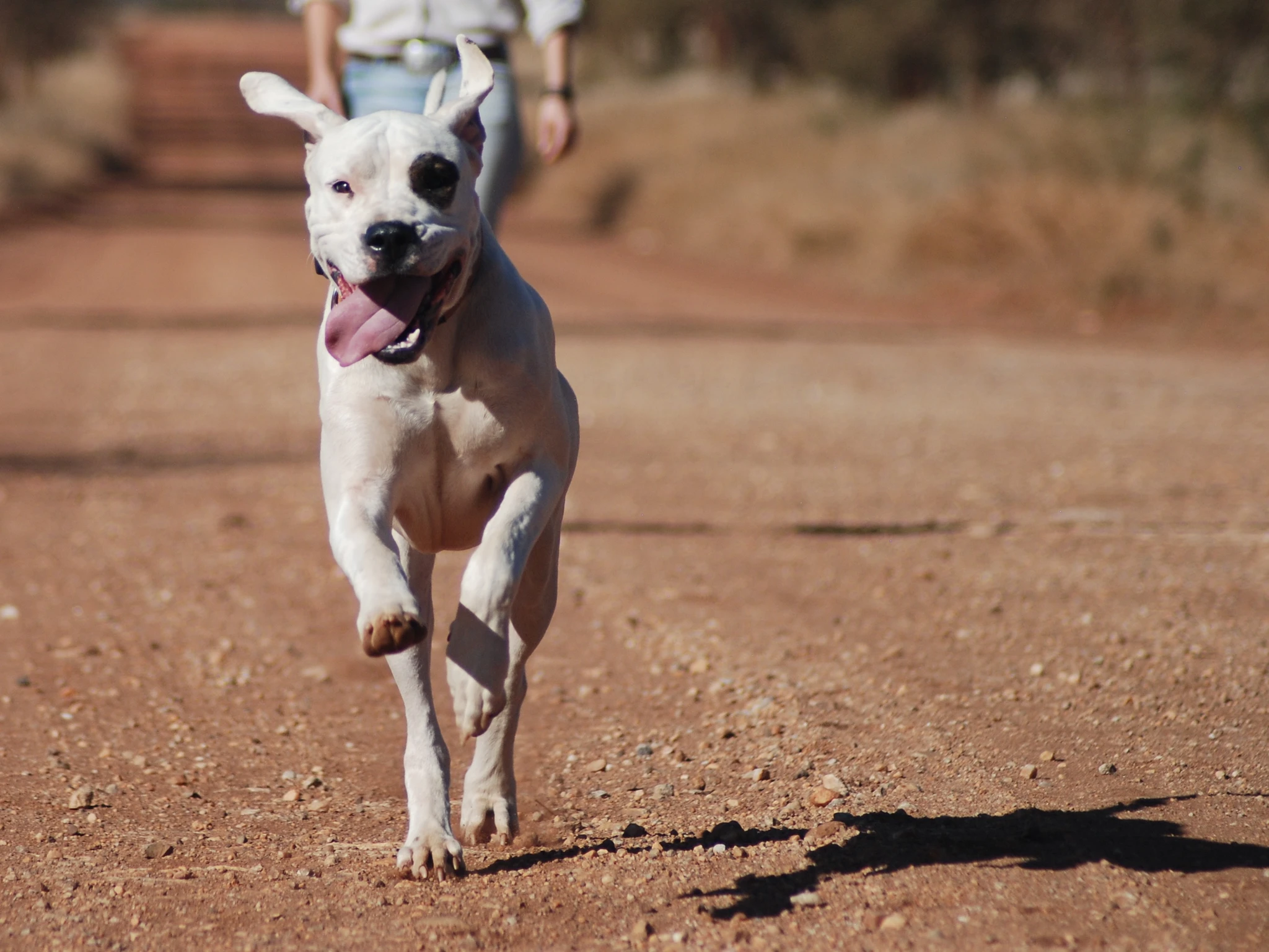
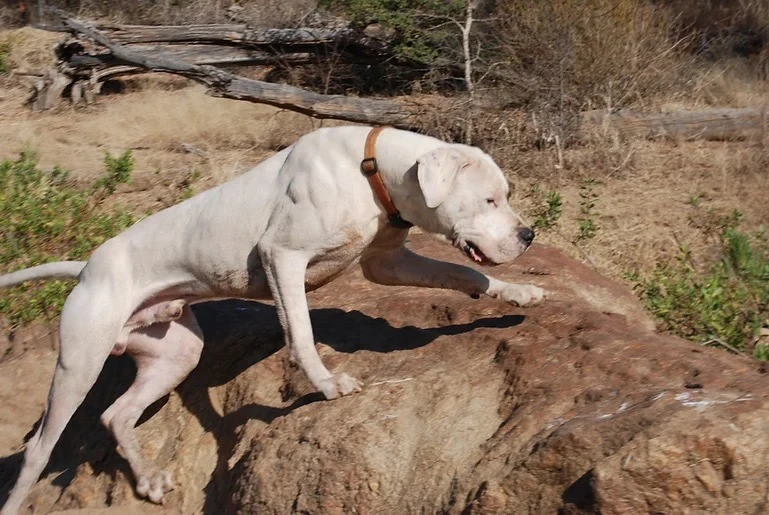
It is an athletic dog, mesomorphic [ed. , normal type, of harmonious proportions. With powerful muscles and agile, his appearance gives the impression of power, energy and strength, in contrast to his expression of friendship and gentleness. All-white; can have a single dark spot on the skull.
IMPORTANT PROPORTIONS
- Mesocephalic [ed. , the muzzle should be the same length as the skull.
- The height at the withers should be slightly greater than the height at the croup.
- Depth of chest should represent at least 50% of the height at the withers.
- The length of the body should exceed the height at the withers by only 10% (maximum).
BEHAVIOUR / TEMPERAMENT
It should be silent, never barking on the trail, with a keen nose and excellent flair, vent, agile, strong, robust and especially brave. Should never be aggressive toward humans, a feature that will be severely observed. It must give you love without condition or reservation.
HEAD
Of mesocephalic type, it looks strong and powerful. The cranio-facial axes [ed. head planes] are convergent.
Cranial Region:
Skull: Compact, convex seen in profile and from the front, due to the outline of the well-developed masticatory [ed. chewing] and neck muscles.
Occiput: Occipital protuberance not visible due to powerful muscles of neck that hide it completely.
Stop: Defined, but should not be deep or have sharp (abrupt) angles.
Facial Region:
As long as the skull, the line joining the two frontal orbital muscles is equidistant from the occiput and the mandibular joint of the upper jaws [ed. the muzzle is as long as the skull; the measurement from the occiput to the joint of the lower jaw (just below the zygomatic arch), is equal to the distance between the eyes.]
Nose: Strongly black-pigmented. Nostrils well-opened.
Muzzle: Same length as the skull, with concave topline.
Lips: Tight, free edges, black-pigmented, never pendulous.
Cheeks: Large, marked, covered by strong skin, without folds. Well-developed masseter muscles.
Jaws and teeth: Jaws correctly positioned, well-developed, and strong, Not under- or overshot; with healthy teeth, large, and with normal implant. Full dentition is recommended. Scissor bite, pincer bite is accepted.
Eyes: Medium size, almond-shaped, dark- or hazel-coloured, lids preferably with black pigmentation. Sub-frontal position [ed. facing forward and slightly oblique ], wide apart, lively, and intelligent expression but at the same time remarkably firm.
Ears:
Set high, lateral, well apart due to the width of the skull.
- Functionally, they should be cropped and erect, in triangular shape, and with a length that should not
- exceed 50% of the front edge of the auricle of the natural ear.
- Without being cropped, they are of medium length, broad, thick, flat, and rounded at the tip. Covered with
- smooth hair that is slightly shorter than on the rest of the body; they can have small spots, not to be penalised. In natural position they hang down covering the back of the cheeks. When the dog is alert, they may be carried semi-erect.
- [*refer note below]
NECK
Thick, arched, the skin of the throat is very thick forming smooth folds without forming dewlap. The elasticity of the skin is due to the cellular tissue being very relaxed.
BODY
Rectangular. The length of the body (measured from the point of shoulder to point of buttock) may exceed the height at the withers by only 10%.
Topline: Higher at the withers, sloping gently to the croup. The adults have a median furrow along the spine caused by the prominence of the spinal muscles. Seen from the side, should not have any depression.
Withers: Strong, well-defined and high.
Back: Very strong, with muscles well-defined.
Loin: Short, broad, very muscular.
Croup: Broad and strong. Moderately inclined.
Chest: Broad and deep. Seen from the front and profile, the sternum must reach down to the level of the elbows, thereby giving maximum breathing capacity. The thorax is long with ribs moderately curved.
Underline and belly: Rising slightly on the bottom line of the chest, never tucked-up, strong, and with good muscle tension.
TAIL
Long, not to exceed the hock joint, thick, medium set. At rest, it hangs down naturally; in action, it is raised in an arc with an ample curve.
LIMBS
Forequarters:
General appearance: Legs straight, vertical, with short, tight toes.
Shoulder: Laid-back, with great muscular development, without exaggerations.
Upper arm: Same length as the shoulder; well-inclined.
Elbow: Sturdy, covered with a thicker and more elastic skin, without folds or wrinkles. Naturally placed against the chest wall.
Forearm: As long as the upper arm, perpendicular to the ground, straight with strong bone and muscles.
Carpus (wrist): Broad and in line with the forearm, without bony prominences or skin folds.
Metacarpus (pastern): Rather flat, well-boned; seen from the side, slightly inclined, without exaggeration.
Hindquarters:
General appearance: Well-muscled, with short pasterns and tight-fitting toes, without dewclaws. Moderate angulation.
Upper thigh: Well-proportioned, with visible and well-developed muscles.
Stifle (knee): Well-angulated.
Lower thigh: Slightly shorter than upper thigh, strong, and muscular.
Hock joint: The tarsus-metatarsus section is short, strong, and firm, ensuring powerful propulsion of the hind limb. Tarsus is robust, with the point of the hock very prominent. Hocks are strong, almost cylindrical and vertical, without dewclaws.
FEET
Forefeet:
With short and tight-fitting toes. With strong, thick, and resistant pads, preferably black-pigmented.
Hind feet:
Similar to forefeet, although somewhat smaller and slightly longer, maintaining the same characteristics.
GAIT / MOVEMENT
Agile and firm; with noticeable modification when showing interest in something, changing into an alert attitude and responding with quick reflexes, typical for this breed. Calm when walking; trot is extended, with good front suspension and powerful rear propulsion. At gallop, the dog shows all of its energy, fully displaying its power. The movement is agile and firm when walking, trotting or galloping. Should be harmonious and balanced, showing a solid body construction. Ambling (pacing) is not accepted and is considered a serious fault.
SKIN
Homogeneous [ed.consistent / uniform], thick, but elastic. The semi-loose subcutaneous tissue [ed. the layer of tissue under the skin] is elastic, without wrinkling, except on the throat, where the subcutaneous tissue is more relaxed. Lips and eyelids pigmented in black are preferred. Black-pigmented skin is not penalised.
COAT
Uniform, short, smooth, with an average length of 1.5cm – 2cm. Density and thickness vary according to climate.
COLOUR
• Entirely white.
* Only one black or dark-coloured patch on the skull, which can also be located on one ear or around one eye. The size of the spot must be in proportion to the size of the head, not exceeding 10% of the latter.
* Comparing two dogs of equal quality, the whiter specimen should be preferred.
SIZE
Height at withers:
Males: 60cm – 68cm (approx. 231⁄2” – 27”); ideal height: 64cm – 65cm (approx. 25” – 251⁄2”)
Females: 60cm – 65cm (approx. 231⁄2” – 251⁄2”); ideal height: 62cm – 64cm (approx. 241⁄2” – 25”)
Weight:
Males: 40kg – 45kg
Females: 40kg – 43kg
FAULTS
Any departure from the foregoing points should be considered a fault and the seriousness with which the fault should be regarded should be in exact proportion to its degree and its effect upon the health and welfare of the dog, and on the dog’s ability to perform its traditional work.
Severe faults:
- Lack of bone and muscle development (weakness).
- Nose partially pigmented in adult specimens.
- Small, weak, or unhealthy teeth.
- Entropion, ectropion. Eyes of round appearance due to the shape of the eyelids, bulging eyes, light or yellow.
- Barrel chest. Keel chest. Flat ribs. Lack of depth of chest, which does not reach the level of the elbows.
- Lack of angulation on the limbs.
- Croup higher than withers.
- Ambling movement (pacing).
- Males and females whose weight does not comply with the official valid standard and not in proportion to the size
- of the dog.
Disqualifying faults:
- Aggressive or overly shy.
- Any dog clearly showing physical or behavioural abnormalities.
- Over or undershot mouth.
- Deafness.
- Lack of type.
- Long hair.
- Total lack of pigmentation of the nose in dogs aged 2 years or more. Brown nose.
- Pendulous lips.
- Spots on the hair of the body. More than one spot on the head.
- Height above or below the limits established in the standard.
- Eyes of different colour or blue.
- Lack of sexual dimorphism.
Photos